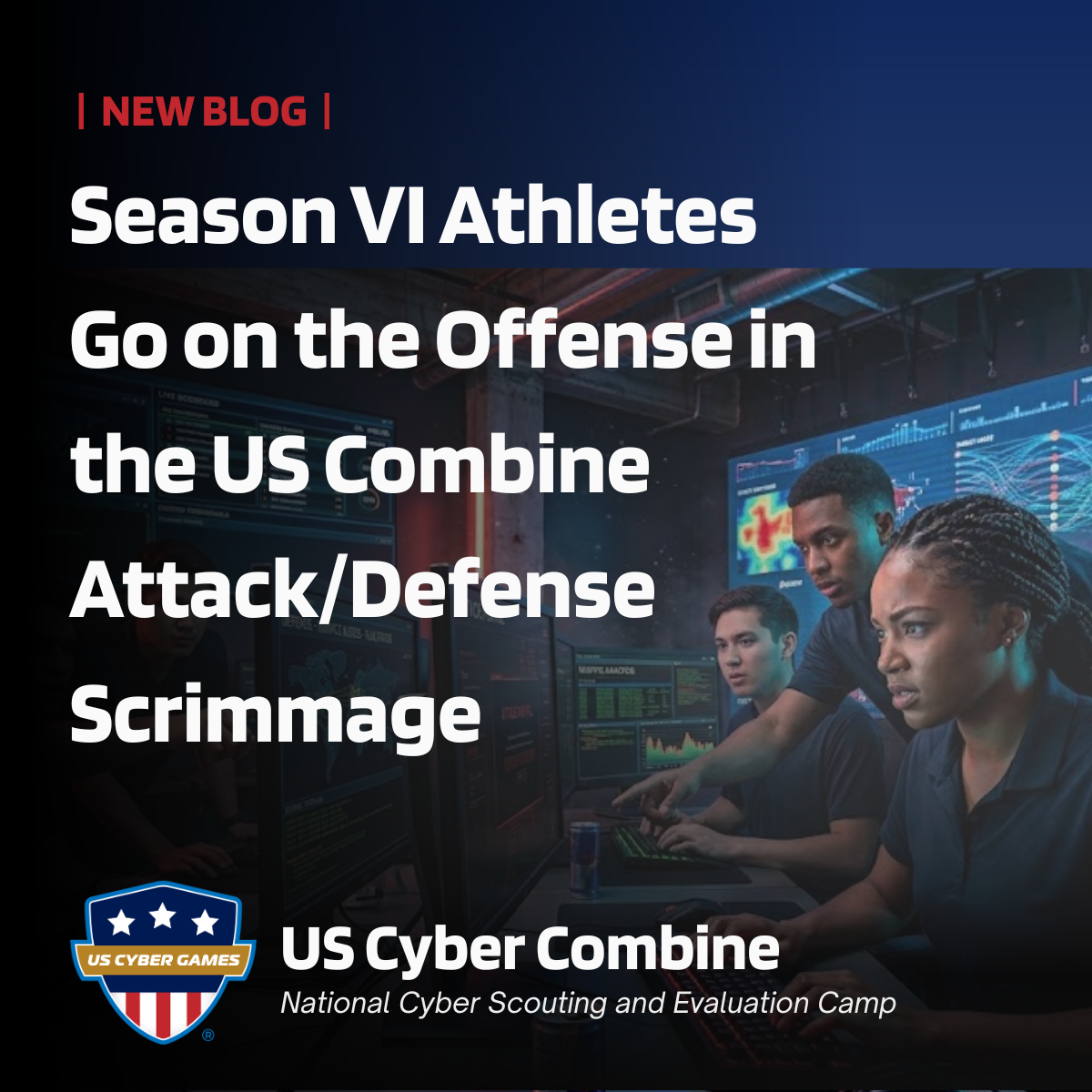
Five hours. 14 teams. 42 cyber athletes. 8,627 flags. And absolutely no timeouts.
As part of Season VI, US Cyber Combine, US Cyber Games athletes recently took on one of the most demanding formats in competitive cybersecurity: Attack/ Defense.
Hosted in the GL1TCH Attack/ Defense environment, the scrimmage put athletes into a live-fire cyber battlefield where the objective was simple (and anything but easy): defend your own services, attack your opponents, capture flags, and stay alive. GL1TCH is purpose-built for dynamic Attack/ Defense competition, giving teams an environment to train, test, and compete against one another in real time.
And the action started fast.
The first “first blood” came just 20 minutes into the game. The final first blood didn't happen until just three minutes before the clock hit zero. In between, teams generated more than 60 GB of network traffic and collectively captured 8,627 flags across the competition.
Four of the five available challenges were solved.
And 12 of the 14 active teams successfully threw at least one exploit.
But the numbers only tell part of the story.
Attack/ Defense isn't a competition where athletes can solve a challenge, grab a flag, and move on. The battlefield keeps moving. A vulnerability discovered by one team can become an attack against another. A patch can stop an exploit — or accidentally break a service. A few seconds spent troubleshooting can mean the difference between gaining ground and watching another team climb the leaderboard.
As one athlete put it, the biggest lesson was simple: “Time is important.”
Another described what makes Attack/ Defense so different from a traditional CTF: “You need to be constantly checking on the scoreboard to keep a lead.”
That's the game. Get points on the board early and often.
Athletes split their time between vulnerability hunting, exploit development, patching, network traffic analysis, monitoring, tooling, and strategy. Some became offensive weapons, relentlessly hunting for ways into opposing services. Others became defensive anchors, keeping their team's infrastructure alive while analyzing incoming attacks. The strongest teams learned to do both — and, more importantly, learned how to communicate while doing it.
For many athletes, the most exciting part was the constant back-and-forth.
Find the vulnerability. Write the exploit. Throw it. Capture the flag. Get attacked. Find the weakness. Patch it. Test it. Do it again.
One athlete described the experience as fundamentally different from a Jeopardy-style CTF because the competition never really stops: “Finding new exploits and having to defend against them makes it so that each service is a continuous competition.”
That constant pressure is exactly why Attack/Defense belongs in the US Cyber Combine. It tests more than technical skill. It shows who can communicate, adapt, recover, and compete when every decision affects the board.
The Combine is not only about identifying who can solve the hardest challenge. It is about identifying athletes who can think, communicate, adapt, and perform under pressure — the same qualities that matter as they progress toward the US Cyber Team.
And the scrimmage delivered plenty of those moments.
Athletes learned how quickly a leaderboard can change. They discovered the importance of preparation and tooling. They experienced the frustration of a patch that does not work as expected and the satisfaction of watching an exploit fail after a successful defense. They learned that sometimes the smartest move is not chasing another vulnerability, but knowing when to pivot, protect a service, or trust a teammate.
They also learned that cybersecurity competition is a team sport.
For some athletes, this was their first real taste of Attack /Defense. For others, it was an opportunity to experiment with new tooling and strategies. Across the board, the scrimmage gave Season VI athletes another opportunity to turn technical knowledge into competitive performance.
And when the clock finally hit zero, the game was over.
But the evaluation wasn't.
Every exploit, patch, decision, communication and recovery gave coaches and mentors another look at what these athletes can do when the pressure is on.
The next generation of US Cyber Team athletes isn't just learning how to hack. They're learning how to compete.
And Season VI is just getting started.
Get Involved with US Cyber Games!
The US Cyber Games is entirely powered by our generous sponsors, and your support is essential to growing the program and empowering the next generation of top cyber talent. Become a sponsor today to directly impact these athletes and fuel their journey to victory. You can also join us as a coach or mentor, or follow our social channels to stay connected with Season VI. Reach out today to help build and expand our championship program!